Why AI Agents Are Harder Than Chatbots
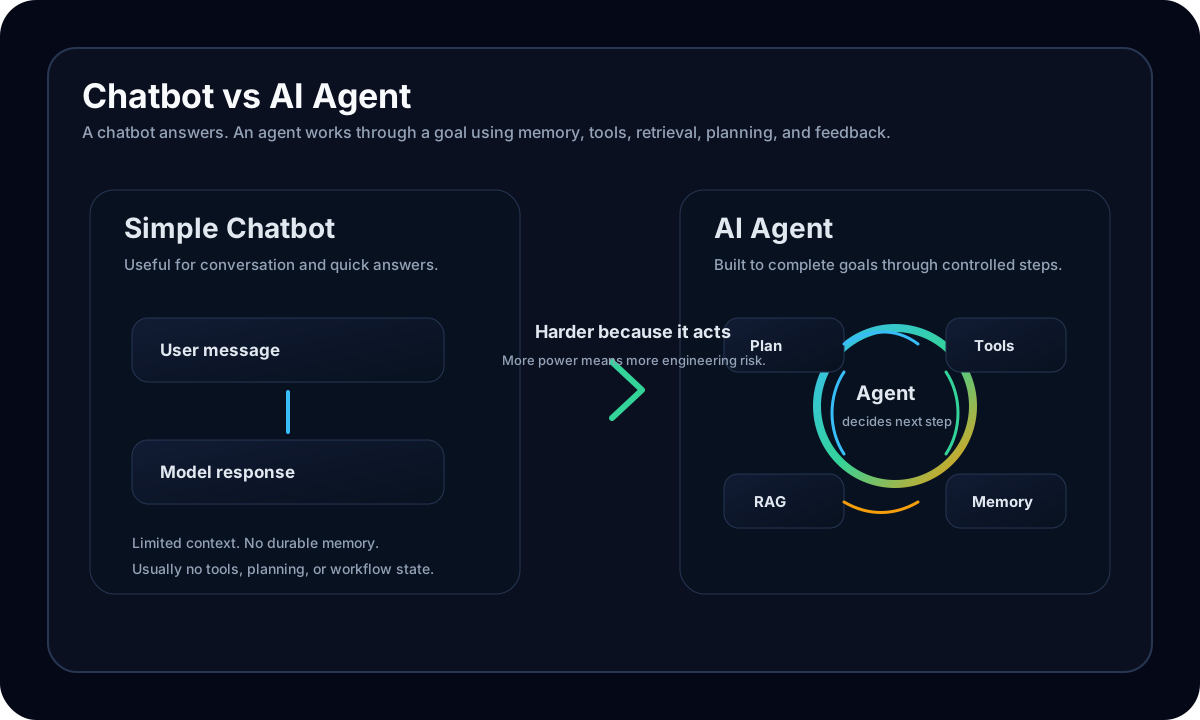
A chatbot can answer a message. An agent has to understand a goal, retrieve knowledge, plan steps, call tools, remember context, observe results, and complete a workflow without losing control.
Responds to a message with a single answer
Plans steps, uses tools, observes results, and continues
More autonomy means more state, cost, and failure modes
Main idea
Agents are harder because they act
Answers one message at a time
Works toward a goal across multiple steps
Usually depends on conversation text
Retrieves knowledge, database records, and external context
Mostly produces text
Can call tools, APIs, automations, and workflows
Easy to demo
Hard to make reliable, safe, affordable, and observable
A chatbot is a conversation. An agent is a workflow.
A simple chatbot usually follows a direct pattern. The user sends a message, the model receives context, and the system returns a response. That can be useful for support, Q and A, brainstorming, summaries, and quick explanations.
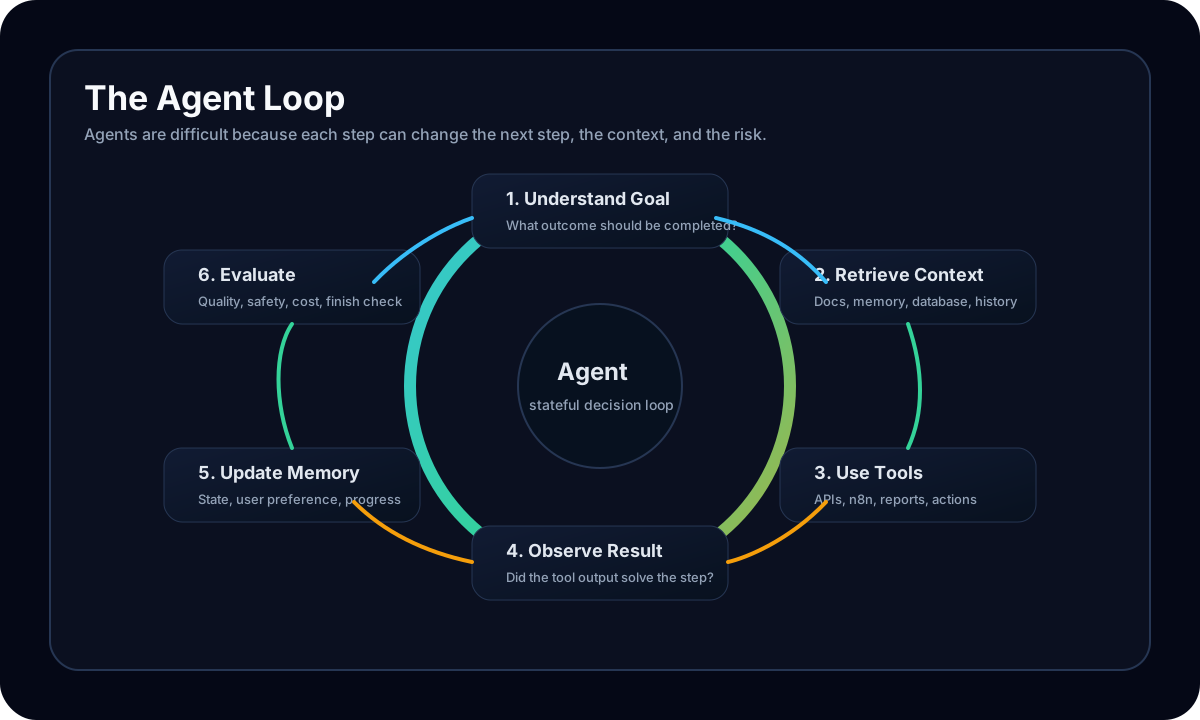
An AI agent is different. It is not only trying to answer. It is trying to complete a goal. To do that, it may need to search knowledge, inspect data, choose a tool, call an API, observe the result, update state, and decide the next step.
This is why agents are powerful, but also harder. The moment the AI can act, the engineering problem becomes bigger than prompting. You now have to design control, state, safety, memory, evaluation, and recovery.
Tool use introduces real-world consequences
A chatbot can be wrong and the user may ignore it. An agent can be wrong and still create a task, send an email, update a record, trigger a workflow, generate an invoice, or call an external API.
Tool calling needs clear schemas, input validation, permissions, logging, retries, and human approval for risky actions. The tool should not be a vague function that accepts anything. It should be a carefully designed interface between AI reasoning and real software behavior.
This is where tools like LangChain, LangGraph, CrewAI, AutoGen, and n8n become interesting. They help structure the workflow, but they do not remove the need for engineering judgment. The developer still has to decide what the agent is allowed to do and how failure is handled.
Retrieval makes agents useful, but retrieval is easy to get wrong
Agents need knowledge. If the system only relies on the model memory, it will miss private business data, product documentation, user history, current records, and domain-specific details.
Vector search helps by retrieving relevant chunks from documents, help centers, internal notes, reports, or customer data. Tools like Pinecone and other vector databases make this possible, but the hard parts are still chunking, metadata, filtering, reranking, freshness, and citations.
A bad retrieval layer makes the agent confident with weak context. A good retrieval layer makes the agent grounded, specific, and useful.
Planning sounds simple until the plan changes
Planning is one of the biggest differences between a chatbot and an agent. A chatbot answers the current message. An agent needs to decide what sequence of steps can complete the goal.
Real workflows are messy. A tool can fail. A retrieved document can be incomplete. A user can change their mind. A step can reveal new information. The agent needs a way to branch, retry, stop, ask a clarifying question, or hand control back to a human.
This is why stateful frameworks such as LangGraph matter. They let you think in nodes, edges, state, loops, and controlled transitions instead of hoping one long prompt will manage everything.
Memory is not the same as chat history
Many people think memory means storing the whole conversation and sending it back to the model. That works for small demos, but it breaks down in serious products.
Real memory has different layers. Short-term memory tracks the current task. Long-term memory stores user preferences, decisions, entities, and past outcomes. Product memory lives in the database: users, projects, invoices, bookings, settings, and workflow state.
The hard question is not whether to remember. The hard question is what to remember, where to store it, when to retrieve it, and how to avoid giving the agent outdated or private information.
Agents become valuable when they complete workflows
The real value of an agent is not that it can chat. The value is that it can reduce manual work. It can turn a goal into a sequence of useful actions.
For a coworking SaaS, an agent might check room availability, summarize bookings, prepare a report, draft a member message, and ask for approval before sending it. For an education product, it might inspect progress, retrieve weak topics, recommend resources, and update a teacher dashboard.
n8n becomes useful here because many business workflows already live across tools. An agent can decide what should happen, while n8n can run the connected automation in a controlled way.
Agent evaluation is harder than chatbot evaluation
A chatbot can often be evaluated by reading the answer. An agent needs deeper evaluation because the result is a path, not only a final response.
Did it choose the right tool? Did it retrieve the right context? Did it stop at the right time? Did it ask for approval before a risky action? Did it spend too many tokens? Did it complete the workflow or only sound confident?
Good agent evaluation includes test tasks, expected tool calls, cost budgets, latency checks, safety rules, human review, and regression tests. Without evaluation, every prompt or graph change can silently make the agent worse.
How I think about the agent stack
I see agent engineering as a stack, not a single library choice. LangChain gives useful building blocks. LangGraph gives structure for stateful workflows. AutoGen and CrewAI help explore multi-agent collaboration. Pinecone and vector databases help ground the agent in knowledge. n8n helps connect decisions to real automations.
But the tool is not the product. The product is the workflow that becomes easier for the user. The engineering work is designing the loop: goal, context, plan, tool, observation, memory, evaluation, and improvement.
The engineering layers behind agents
Planning
The agent has to break a goal into steps, decide what to do next, and recover when the plan does not work.
Tool calling
The agent can call APIs, create tasks, send messages, generate reports, trigger n8n workflows, or update systems.
Retrieval
The agent needs the right context from vector databases, documents, product data, and previous interactions.
Memory
The agent may need short-term state, user preferences, task progress, history, and durable records.
Control
Permissions, approvals, validation, and guardrails decide what the agent can safely do.
Cost and latency
Multi-step reasoning can call models and tools many times, so the system needs budgets, limits, and monitoring.
Practical stack map
- LangChain for chains, tools, retrievers, and common LLM application building blocks.
- LangGraph for stateful agent flows where steps, branches, memory, and recovery paths matter.
- AutoGen and CrewAI for multi-agent collaboration, role-based agents, and experimentation.
- Pinecone or another vector database for semantic retrieval and knowledge grounding.
- n8n for workflow automation when agent decisions need to trigger operational actions.
- Evaluation, logging, and human review so agent behavior improves instead of drifting silently.
Final thought
Chatbots are easier because the output is usually a message. Agents are harder because the output is behavior. They need planning, retrieval, memory, tools, safety, cost control, observability, and evaluation. That is exactly why they are worth learning carefully.
View my portfolio